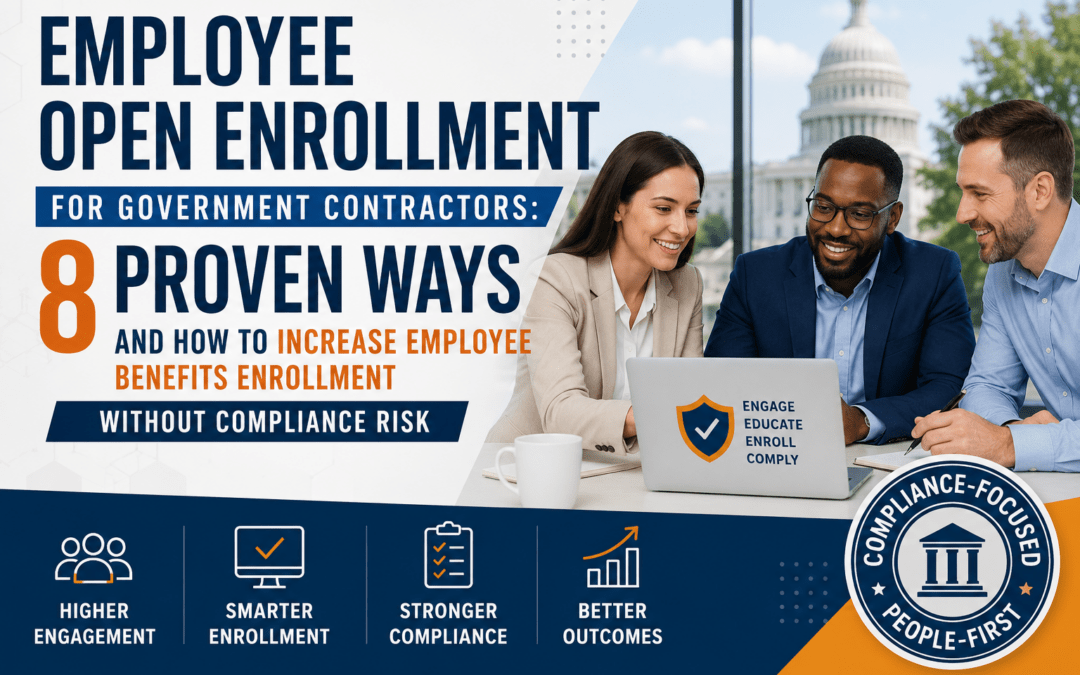
Employee Open Enrollment Management for Government Contractors: 8 Proven Ways and How to Increase Employee Benefits Enrollment Without Compliance Risk
Table of Contents
Introduction
For government contractors and subcontractors, employee open enrollment is not just an annual HR event—it is a compliance-sensitive operational window that directly impacts workforce stability, contract performance, and regulatory alignment. Unlike traditional private-sector environments, contractors working under federal or state-funded agreements must ensure that benefits administration aligns with strict wage determinations, Service Contract Act (SCA) requirements, and audit-ready documentation standards.
Yet despite its importance, many organizations still struggle with participation. Employees delay decisions, ignore communications, or default out of benefits entirely. This creates downstream issues such as coverage gaps, compliance exposure, and increased administrative burden.
The real challenge is not just running employee open enrollment—it is understanding how to increase employee benefits enrollment in a way that is consistent, scalable, and compliant.
This article explores eight proven strategies tailored specifically for government contractors. Each section breaks down practical approaches that HR leaders, compliance teams, and benefits administrators can implement to improve engagement, strengthen communication, and ultimately increase participation without increasing compliance risk.
Understanding Employee Open Enrollment in Government Contracting and How to Increase Employee Benefits Enrollment With Confidence
In government contracting environments, employee open enrollment operates under a unique set of constraints that do not typically apply to commercial employers. Contractors must balance employee needs with federal regulations, wage determinations, fringe benefit obligations, and contract-specific labor clauses. This creates a layered complexity that makes benefits enrollment both critical and high-risk.
At its core, employee open enrollment is the designated period when employees can enroll in or make changes to their health insurance, retirement plans, and voluntary benefits. However, for government contractors, this process is deeply connected to compliance obligations. For example, under SCA-covered contracts, employers must ensure that fringe benefits meet minimum requirements, which may include health insurance contributions, paid leave, or cash equivalents.
This is where many organizations struggle with how to increase employee benefits enrollment effectively. Employees often do not understand the value of their benefits package, especially when working in high-turnover or dispersed labor environments such as security services, maintenance contracts, or logistics operations.
To increase participation, contractors must first build clarity. Employees need to understand not just what benefits are offered, but why they matter in the context of their compensation package. When communication is unclear or overly technical, employees disengage, leading to low enrollment rates.
Another key factor is timing and structure. Many government contractors operate across multiple sites or states, making it difficult to coordinate consistent messaging during employee open enrollment. Without centralized planning, employees receive fragmented information, which reduces trust and engagement.
Improving participation starts with simplifying the experience. When employees are given clear instructions, easy-to-access enrollment platforms, and consistent messaging, they are significantly more likely to engage. This is one of the most effective ways to improve employee open enrollment outcomes and directly supports how to increase employee benefits enrollment without increasing administrative burden.
Ultimately, confidence in the process comes from structure, clarity, and compliance alignment. Contractors who treat employee open enrollment as a strategic workforce event—not just an HR deadline—see stronger participation and fewer compliance risks.
Why Employees Ignore Employee Open Enrollment Communications and How to Increase Employee Benefits Enrollment Through Better Messaging
One of the biggest barriers to successful employee open enrollment is not the benefits themselves—it is communication failure. Employees often ignore emails, skip meetings, or fail to complete enrollment because the messaging does not resonate with their daily experience or priorities.
Government contractors face an additional challenge: workforce diversity. Employees may include administrative staff, field technicians, security personnel, and contract specialists, all of whom receive and process information differently. When messaging is generic, it fails to connect.
To understand how to increase employee benefits enrollment, organizations must first address why employees disengage. Common reasons include information overload, unclear value propositions, lack of urgency, and inconsistent communication channels.
Many HR teams rely heavily on email as the primary communication tool during employee open enrollment. However, in contractor environments, employees may not regularly check email, especially in operational roles. This leads to missed deadlines and reduced participation.
Improving engagement requires a multi-channel communication strategy. Messaging should be repeated across email, text alerts, digital dashboards, and supervisor-led discussions. The goal is not just distribution but reinforcement.
Equally important is message clarity. Employees need simple, direct explanations of what is changing, what action they must take, and what they gain by participating. When communication is filled with jargon or compliance language, it reduces engagement and creates confusion.
Another critical factor in how to increase employee benefits enrollment is personalization. Employees are more likely to engage when messaging reflects their specific situation, such as family coverage options, cost changes, or new plan offerings. Personalized messaging increases relevance, which directly improves participation rates.
Storytelling can also be a powerful tool. Instead of presenting benefits as abstract offerings, HR teams can highlight real-world scenarios such as how medical coverage supports families or how voluntary benefits provide financial protection during emergencies.
When communication is done correctly, employee open enrollment becomes less of a compliance obligation and more of a valued employee experience. This shift is essential for government contractors seeking higher participation rates without increasing administrative pressure.
Digital Solutions That Transform Employee Open Enrollment Participation and How to Increase Employee Benefits Enrollment Efficiently
Technology plays a central role in modern employee open enrollment strategies, especially for government contractors managing distributed workforces across multiple job sites and regions. Digital transformation is no longer optional—it is a necessity for scalability, compliance tracking, and improved engagement.
One of the most effective ways to understand how to increase employee benefits enrollment is by implementing user-friendly enrollment platforms that simplify decision-making. These systems allow employees to compare plans, estimate costs, and complete enrollment from any device, reducing friction and increasing completion rates.
Self-service portals are particularly valuable in contractor environments where employees may work non-traditional hours or in field-based roles. When employees can complete enrollment on their own schedule, participation naturally increases.
Automation also plays a critical role. Automated reminders, deadline alerts, and enrollment confirmations ensure that employees remain engaged throughout the employee open enrollment window. This reduces reliance on manual follow-ups from HR teams, which can be inconsistent or delayed.
Another powerful digital tool is decision-support software. These tools guide employees through benefits selection based on their personal needs, such as family size, expected healthcare usage, or budget preferences. This directly supports how to increase employee benefits enrollment by reducing confusion and decision fatigue.
Data analytics further enhances the process. HR teams can track participation trends, identify departments with low engagement, and adjust communication strategies in real time. This allows for continuous improvement rather than reactive problem-solving after enrollment closes.
For government contractors, compliance tracking is equally important. Digital systems provide audit-ready records of employee elections, waiver forms, and acknowledgment receipts. This reduces compliance risk while improving operational efficiency.
Ultimately, technology transforms employee open enrollment from a manual administrative burden into a streamlined, data-driven process that supports higher engagement and better outcomes.
Training Managers to Support Employee Open Enrollment Success and How to Increase Employee Benefits Enrollment from the Front Line
Managers play a critical yet often underutilized role in employee open enrollment success. In government contracting environments, where employees may be dispersed across job sites, managers are often the most trusted source of information.
When employees are unsure about benefits, they frequently turn to their direct supervisor rather than HR. This makes manager training a key factor in how to increase employee benefits enrollment effectively.
Unfortunately, many organizations fail to equip managers with the tools and knowledge they need. As a result, misinformation spreads, or employees receive incomplete guidance, leading to lower participation rates.
Effective manager training should focus on three areas: understanding benefits basics, communicating key enrollment messages, and reinforcing deadlines. Managers do not need to be benefits experts, but they do need to confidently explain where employees can find information and why enrollment matters.
Another important strategy is providing managers with standardized talking points and communication templates. This ensures consistency across departments and reduces the risk of conflicting messages during employee open enrollment.
Front-line leadership engagement also increases accountability. When managers are measured on team participation rates, they are more likely to actively encourage enrollment and follow up with employees who have not completed the process.
In addition, managers can play a motivational role. Simple conversations about benefits during team meetings or one-on-one check-ins can significantly improve engagement. Employees are more likely to act when they feel personally encouraged rather than passively informed.
By empowering managers, government contractors create a decentralized communication model that strengthens overall participation and directly improves how to increase employee benefits enrollment without increasing HR workload.
Long-Term Strategies to Optimize Employee Open Enrollment Cycles and How to Increase Employee Benefits Enrollment Sustainably
Sustainable success in employee open enrollment requires more than annual campaign adjustments. Government contractors must build long-term systems that continuously improve participation, compliance readiness, and employee understanding.
One of the most effective long-term strategies is year-round benefits education. Instead of waiting for enrollment season, organizations should consistently communicate the value of benefits throughout the year. This builds familiarity and reduces decision-making pressure during open enrollment.
Another key strategy is post-enrollment analysis. Reviewing participation data, identifying drop-off points, and evaluating communication effectiveness helps refine future strategies for how to increase employee benefits enrollment.
Contractors should also implement feedback loops. Employee surveys after enrollment can reveal confusion points, communication gaps, and platform issues. This feedback is essential for continuous improvement.
Standardizing the employee open enrollment process across all contract locations is another critical step. Consistency reduces confusion, ensures compliance alignment, and improves scalability.
Additionally, integrating benefits education into onboarding ensures that new employees are prepared before they reach their first enrollment cycle. This proactive approach significantly improves participation rates over time.
Finally, aligning benefits strategy with workforce planning ensures that employee open enrollment is not treated as a standalone HR task but as part of a broader talent and retention strategy.
Call to Action
If you would like to learn more about Employee Open Enrollment and how they can help you with higher engagement, contact Cornerstone SCA at 405-513-0767 today for a free no obligation consultation.
Conclusion
Improving participation in employee open enrollment is not about a single tactic—it is about building a system that combines communication, technology, leadership engagement, and long-term planning. For government contractors, the stakes are even higher due to compliance requirements and workforce complexity.
By focusing on clear messaging, digital transformation, manager involvement, and continuous improvement, organizations can significantly strengthen participation rates while reducing compliance risk. More importantly, they can create a benefits experience that employees understand, value, and actively engage with year after year.
When executed correctly, understanding how to increase employee benefits enrollment becomes less of a challenge and more of a competitive advantage in securing and retaining government contracts.