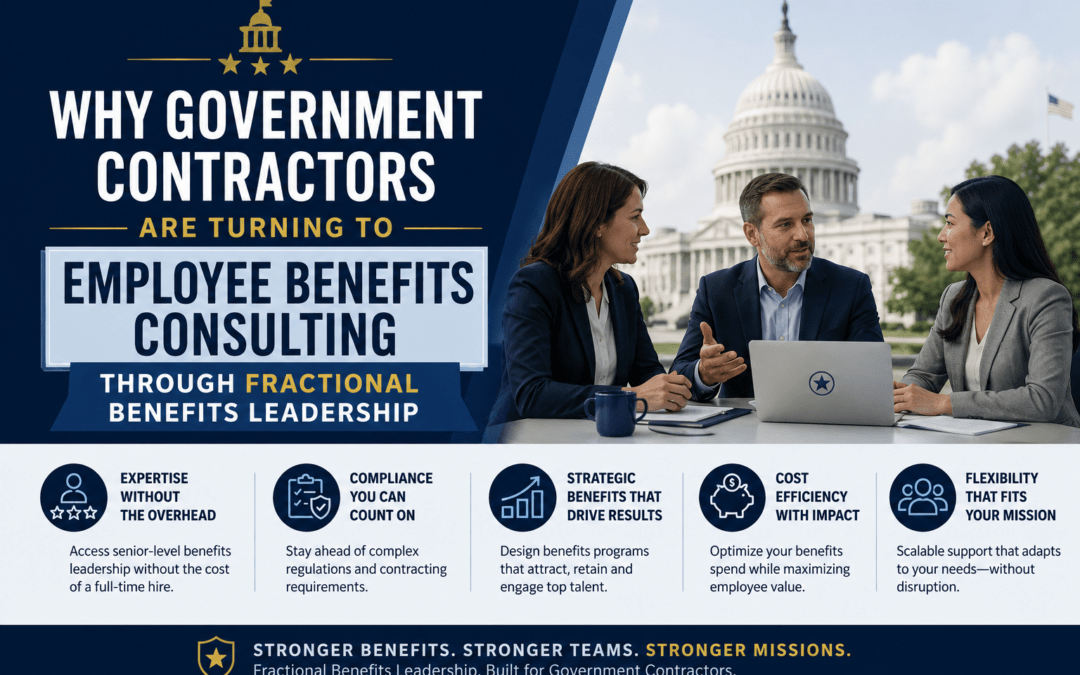
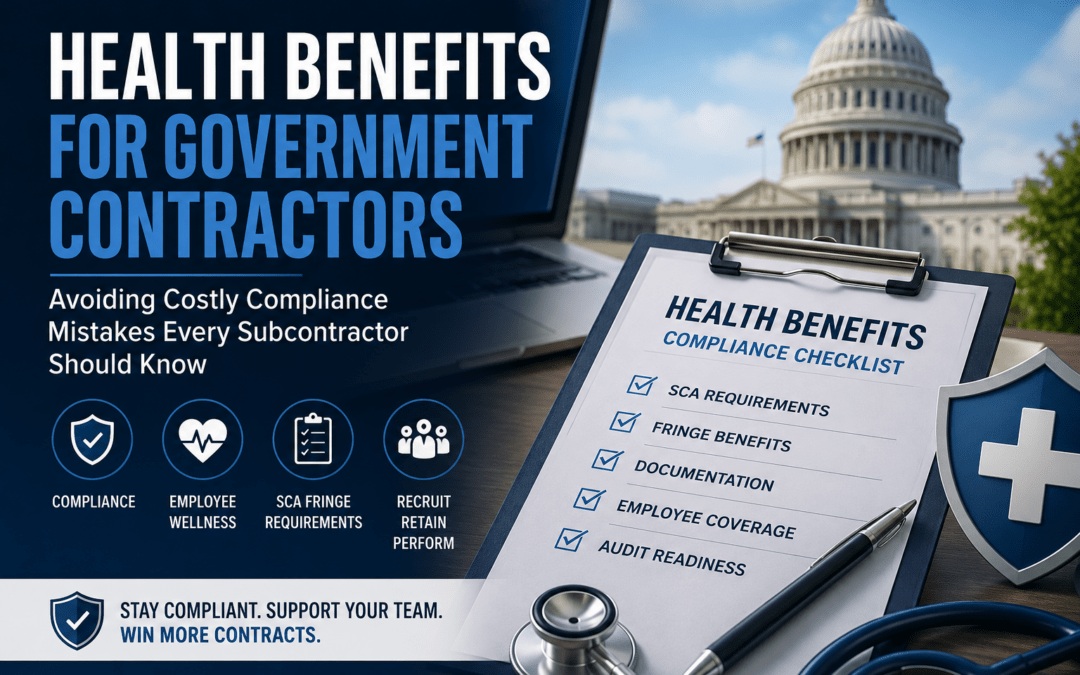
Health Benefits for Government Contractors: Avoiding Costly Compliance Mistakes Every Subcontractor Should Know
Table of Contents
Introduction to Health Benefits for Government Contractors
In today’s federal contracting environment, health benefits for government contractors are no longer just a standard HR offering—they are a compliance-driven, competitive necessity. For subcontractors working under prime federal contracts, especially those governed by labor standards such as the Service Contract Act (SCA) or Davis-Bacon Act, the way health benefits are structured, funded, documented, and administered can directly impact contract eligibility, profitability, and long-term sustainability.
Too often, subcontractors underestimate how deeply health benefits for government contractors are tied to federal compliance requirements. What appears to be a simple HR decision—choosing a medical plan, setting employer contributions, or offering supplemental coverage—can quickly become a legal and financial risk if it is not aligned with wage determinations, fringe benefit obligations, and audit expectations.
In 2026, enforcement scrutiny is increasing. Federal agencies and prime contractors are placing more responsibility on subcontractors to demonstrate compliance with fringe benefit requirements, accurate benefit valuation, and consistent employee coverage across classifications and job sites. At the same time, workforce shortages across technical, logistics, cybersecurity, and defense-related roles have made benefits strategy a critical differentiator in winning and retaining contracts.
This article explores how health benefits for government contractors influence contract success, where compliance risks commonly emerge, how they align with SCA fringe requirements, and how subcontractors can use benefits strategically to improve recruitment, retention, and performance. Most importantly, it outlines how to build a long-term compliance strategy that protects profitability while strengthening competitive positioning in the federal marketplace.
How Health Benefits for Government Contractors Influence Winning and Retaining Federal Contracts
The role of health benefits for government contractors extends far beyond employee satisfaction—it directly influences contract awards, renewals, and performance evaluations. Federal procurement officers and prime contractors increasingly evaluate subcontractors based on workforce stability, compliance readiness, and total compensation strategy, which includes health benefits.
When subcontractors bid on federal work, they are not only competing on price and capability. They are also competing on perceived reliability. A subcontractor that demonstrates strong, compliant, and sustainable health benefits for government contractors signals operational maturity. This becomes especially important in long-term service contracts where workforce continuity is critical to mission success.
Prime contractors are responsible for downstream compliance. As a result, they carefully evaluate subcontractors’ benefit structures to ensure alignment with federal requirements such as SCA wage determinations or agency-specific clauses. If a subcontractor’s health benefits structure appears inconsistent, underfunded, or poorly documented, primes may view them as a compliance risk—reducing the likelihood of award or continuation on a contract.
Additionally, many solicitations now include indirect evaluation criteria related to labor stability and employee retention strategies. Strong health benefits for government contractors programs help demonstrate that a subcontractor can maintain staffing levels without excessive turnover, which is a major risk factor in contract performance.
Retention is equally important after contract award. Subcontractors often operate in highly competitive labor markets where employees can easily transition between federal contractors. If health benefits are weak or inconsistently applied, turnover increases, leading to training costs, productivity loss, and potential contract penalties for failing to meet staffing requirements.
Another critical factor is pricing strategy. Health benefits directly influence labor burden rates and fringe calculations. Subcontractors who fail to accurately integrate health benefits for government contractors into their pricing models risk underbidding contracts and absorbing losses once benefit obligations are fully realized.
On the other hand, subcontractors that strategically design benefits packages aligned with contract requirements can achieve both competitiveness and profitability. For example, properly structured health benefits can be partially offset through compliant fringe allocation, helping stabilize labor costs while still offering attractive employee packages.
Ultimately, strong health benefits are not just a compliance necessity—they are a strategic advantage in winning and retaining federal contracts in an increasingly competitive procurement environment.
The Biggest Compliance Challenges Facing Health Benefits for Government Contractors Today
Despite their importance, managing health benefits for government contractors is one of the most complex compliance areas for subcontractors. The challenges stem from overlapping regulations, evolving labor rules, and the need to align HR systems with federal contract requirements.
One of the biggest challenges is benefit valuation. Under federal rules, especially the Service Contract Act, health benefits must be properly calculated as part of fringe obligations. Many subcontractors struggle to accurately determine the hourly value of benefits such as medical coverage, dental insurance, and supplemental health plans. Miscalculations can result in underpayment of fringe obligations, leading to back pay liability during audits.
Another major issue is inconsistent application across employee classifications. Subcontractors often manage multiple labor categories—full-time, part-time, exempt, non-exempt, and temporary staff. Ensuring that health benefits for government contractors are applied consistently and in accordance with contract terms is a frequent audit failure point.
Documentation is also a significant compliance risk. Federal auditors expect clear records showing how benefits are offered, calculated, and distributed. Without structured documentation systems, subcontractors may struggle to prove compliance even if benefits are technically correct. This is particularly problematic when working under multiple contracts with varying wage determinations.
A further challenge is coordination between payroll and benefits systems. Many compliance issues arise when payroll systems do not properly integrate health benefit deductions, employer contributions, or fringe credit allocations. This disconnect can result in inaccurate reporting and compliance discrepancies that surface during audits.
Subcontractors also face challenges related to benefit eligibility tracking. Employees moving between contracts or job sites may inadvertently fall out of eligibility or receive inconsistent coverage. This creates both compliance exposure and employee dissatisfaction.
Finally, regulatory interpretation itself is complex. Guidance around what qualifies as creditable fringe under SCA rules continues to evolve, and subcontractors must stay current on Department of Labor interpretations, wage determinations, and contract-specific clauses.
Without a structured compliance framework, health benefits for government contractors can quickly become a liability rather than an asset. Addressing these challenges requires proactive systems, not reactive fixes.
Aligning Health Benefits for Government Contractors with SCA Fringe Benefit Requirements
One of the most critical compliance areas for subcontractors is aligning health benefits for government contractors with the Service Contract Act (SCA) fringe benefit requirements. The SCA mandates that covered employees receive a minimum level of fringe compensation in addition to base wages, and health benefits are one of the most common methods of satisfying this obligation.
To achieve compliance, subcontractors must first understand that fringe benefits are not optional enhancements—they are required compensation components. Health insurance, medical reimbursements, and employer contributions to health plans can all be used to meet fringe obligations, but only when properly structured and documented.
A key requirement is that health benefits must be “bona fide” and consistently provided. This means health benefits for government contractors cannot be selectively applied or offered in a way that favors certain employees without justification. If benefits are not uniformly available to eligible employees under a covered contract, they may not be fully creditable toward fringe obligations.
Another important aspect is hourly valuation. Subcontractors must convert monthly or annual health benefit costs into an hourly equivalent to ensure they meet or exceed SCA fringe requirements. Errors in this calculation can result in underfunding fringe obligations, which may lead to wage restitution claims or contract penalties.
Additionally, subcontractors must ensure that health benefits are not double-counted. For example, if a portion of health insurance costs is already credited toward fringe requirements, it cannot be reused in another cost category. Proper accounting separation is essential to avoid compliance violations.
Documentation plays a central role in alignment. Subcontractors must maintain clear records showing how health benefits for government contractors are allocated across employees and contracts. This includes plan summaries, employer contribution records, payroll integration reports, and eligibility tracking documentation.
Coordination with prime contractors is also essential. Many primes require subcontractors to certify compliance with fringe requirements and may audit benefit structures periodically. Failure to align properly with SCA expectations can jeopardize subcontractor status on existing contracts.
Ultimately, aligning health benefits with SCA requirements is not just about compliance—it is about building a defensible, audit-ready system that supports long-term federal contracting success.
Using Health Benefits for Government Contractors to Strengthen Recruitment, Retention, and Performance
Beyond compliance, health benefits for government contractors serve as one of the most powerful tools for workforce management. In a competitive federal labor market, benefits often matter as much as salary when candidates choose between employers.
Recruitment is the first area where benefits have a direct impact. Skilled workers in cybersecurity, engineering, logistics, and defense support roles are frequently evaluating multiple offers simultaneously. Subcontractors offering strong health benefits for government contractors—including comprehensive medical coverage, low deductibles, and family options—gain a clear advantage in attracting qualified talent.
Retention is even more important. High turnover is one of the most costly issues in federal contracting environments. Every time an employee leaves, subcontractors incur replacement costs, training delays, and potential contract performance risks. Competitive health benefits reduce voluntary turnover by increasing employee satisfaction and perceived job security.
Health benefits also influence morale and productivity. Employees who feel supported through reliable healthcare coverage are more likely to remain engaged and focused on contract deliverables. This leads to improved performance metrics, fewer absenteeism issues, and stronger overall contract execution.
Another often-overlooked factor is brand reputation. Subcontractors known for strong health benefits for government contractors are more likely to be recommended by current and former employees. In industries where word-of-mouth and referrals play a significant role, this can significantly reduce hiring costs and improve candidate quality.
Additionally, benefits can be strategically used to stabilize staffing on long-term federal contracts. Instead of relying solely on wage increases—which can strain contract budgets—subcontractors can use structured benefits packages to create long-term value for employees while maintaining financial predictability.
Performance management is also indirectly impacted. Employees who are less stressed about healthcare access or financial strain are more likely to perform consistently and remain compliant with operational standards. This is especially important in high-security or mission-critical environments where reliability is essential.
In short, health benefits for government contractors are not just a compliance requirement—they are a strategic workforce investment that directly influences recruitment success, retention stability, and contract performance outcomes.
Creating a Long-Term Compliance Strategy for Health Benefits for Government Contractors in 2026
Developing a long-term strategy for health benefits for government contractors requires moving beyond reactive compliance and toward a structured, systems-based approach. In 2026, subcontractors must prepare for increased audit activity, tighter labor scrutiny, and more integrated compliance expectations from prime contractors.
The foundation of a strong strategy is centralized benefits governance. Subcontractors should implement a single system for managing eligibility, benefit valuation, payroll integration, and documentation. This ensures that health benefits for government contractors are consistently applied across all contracts and employee groups.
Next is audit readiness. Subcontractors should assume that every federal contract could be audited at any time. This means maintaining real-time documentation of benefit contributions, fringe allocations, and eligibility tracking. Waiting until an audit occurs is no longer a viable strategy in today’s federal environment.
Another key component is integration between HR, payroll, and contract management systems. When these systems operate independently, compliance gaps emerge. A long-term strategy ensures that health benefits for government contractors are automatically aligned with contract requirements, wage determinations, and billing structures.
Ongoing training is also essential. HR teams, payroll administrators, and contract managers must all understand how benefits interact with federal compliance rules. Without cross-functional understanding, even well-designed systems can fail in execution.
Strategic forecasting should also be included. Subcontractors must anticipate how benefit costs will change over time and how those changes will affect contract pricing and fringe obligations. This allows for proactive adjustments rather than reactive corrections.
Finally, subcontractors should establish periodic compliance reviews, ideally quarterly or biannually, to evaluate whether their health benefits for government contractors remain aligned with evolving regulations and contract requirements. These reviews should include both internal audits and external consulting support when necessary.
A long-term compliance strategy is not just about avoiding penalties—it is about creating operational stability, protecting margins, and positioning the subcontractor as a trusted federal partner.
Conclusion
In the federal contracting ecosystem, health benefits for government contractors are far more than an HR function—they are a critical compliance requirement, a workforce strategy, and a competitive advantage. Subcontractors who fail to properly structure, document, and integrate their benefits programs expose themselves to financial risk, audit findings, and contract instability.
However, those who take a proactive approach—aligning benefits with SCA requirements, integrating systems, and using benefits strategically for recruitment and retention—position themselves for long-term success in the federal marketplace.
As 2026 brings increased scrutiny and higher expectations, subcontractors must treat health benefits for government contractors as a core part of their compliance infrastructure. Done correctly, they not only protect contracts but also strengthen the workforce and improve overall performance across every engagement.